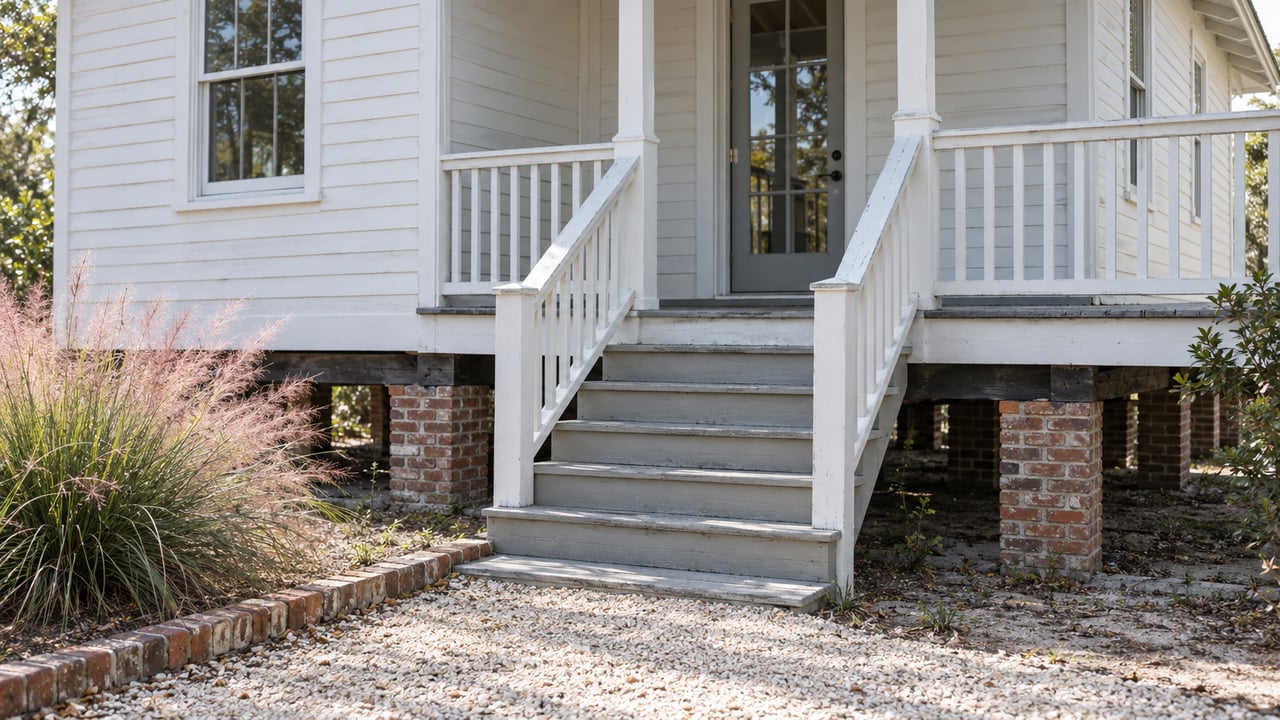
At the Apalachicola Planning and Zoning Commission's April 2026 meeting, a contractor stood before the board to walk through a project that sounded routine on paper: bringing brick up to a set of pilings, with weep holes built into the wall so water could drain and a concrete footer poured below grade so the brick never touched bare soil. Board member Bobby Miller noted there was already a brick wall near the historic Chapman house, so the material wasn't foreign to the district. Then another board member, Ashley Leonard, raised a different concern entirely. The work sat near wetlands regulated by the Florida Department of Environmental Protection, and the city attorney had to clarify, on the record, that the city itself has no authority there. Before the vote, someone flagged that the stormwater management plan looked incomplete and that the floodplain development permit hadn't been obtained yet.
This is what buying a historic home in Apalachicola actually involves once you own it. The house you're touring this weekend sits inside a review process that has at least three separate tracks, run by three separate offices, on three separate timelines, and none of them wait for the others to finish.
Two Approvals, Two Different Clocks
Apalachicola's Planning and Zoning Commission does double duty. It reviews standard building permits and site plans, and it also acts as the city's Architectural Review Board for anything inside the Historic District, which was added to the National Register of Historic Places in 1980 and covers roughly 4,600 acres and 652 historic buildings along the river and bay. Any exterior alteration or new construction on a contributing structure needs a Certificate of Appropriateness from this board before work starts.
That's the part most buyers expect. What catches people off guard is that a Certificate of Appropriateness only answers one question: does the work look right for the district? It says nothing about whether the floodplain administrator has signed off on elevation and fill requirements tied to federal flood insurance rules, and it says nothing about whether FDEP has cleared an impact on adjacent wetlands. Those are different agencies asking different questions, and a project can clear the aesthetic review while still missing a permit that has nothing to do with how the brick looks.
| Review | Who Runs It | What It Evaluates | If It's Skipped |
|---|---|---|---|
| Certificate of Appropriateness | City of Apalachicola Planning and Zoning Commission, acting as Architectural Review Board | Materials, massing, whether work matches the character of a contributing structure | Work can be stopped or ordered undone |
| Floodplain Development Permit | City floodplain administrator | Elevation, fill, and substantial improvement thresholds under NFIP rules | Property can lose standing under the National Flood Insurance Program |
| Wetlands Permit | Florida Department of Environmental Protection | Impact on adjacent wetlands or waterways | Enforced separately from any city approval, regardless of what the board approved |
| 4-Point Inspection | Florida-licensed inspector, ordered by the insurer | Age and condition of roof, electrical, plumbing, and HVAC | Carrier can decline coverage or decline renewal |
What Actually Comes Before the Board in a Given Month
The February 2026 agenda gives a sense of how often this touches ordinary transactions. In that single meeting, the board reviewed a fence permit for Marie Garrett at 278 Prado Street, an alteration and renovation for Jerry Hood at 36 Myrtle Avenue, new residential construction for Stephen and Betty Bailey at 104 9th Street, an alteration for Christopher and Sabrina Fornes at 96 Avenue D, and new construction for Thomas Griffith at 260 6th Street.
None of those are unusual projects. A fence, a renovation, a new build on an existing lot. The takeaway isn't that Apalachicola makes renovation difficult. It's that the threshold for triggering a review is lower than most buyers assume. If you're picturing a full gut renovation as the only scenario that needs board sign-off, the actual case list says otherwise. A fence needs it. A new porch needs it. The scope of the project matters less than whether it's visible from the street inside the district boundary.
The House Can Pass the City and Still Fail the Insurer
Separately from anything the Planning and Zoning Commission reviews, Florida property insurers run their own evaluation, and it has nothing to do with historic character. Citizens Property Insurance Corporation requires a four-point inspection, covering roof, electrical, plumbing, and HVAC, for any property more than 20 years old. Given that a meaningful share of homes in Apalachicola's historic core were built well before 1980, this isn't an edge case. It's close to standard procedure for anyone buying in the district.
The electrical piece is where things get specific. Homes wired before 1980 sometimes still carry cloth wiring, knob-and-tube wiring, or aluminum wiring, and carriers treat each differently. Aluminum wiring can sometimes be insured if it's been repaired with an approved connector method, but even then only a portion of carriers will accept it. Cloth and knob-and-tube wiring are harder sells across the board. Certain older panel brands, including Zinsco, Federal Pacific Electric, Sylvania, and Challenger, carry documented histories of breakers failing to trip during overloads, and most carriers will require full replacement of both the panel and any outdated wiring before writing a policy.
Rewiring a historic home costs more than rewiring a newer one, because plaster walls and older framing make the work harder to access and because contractors often work to preserve original features while they're in there. Budgets for a full rewire in a historic property can run well past $25,000 before permit and inspection fees, which typically add another $200 to $500 depending on the county. None of that is a city cost. It's an insurance and electrical contractor cost that shows up after closing, sometimes triggered by the very inspection the mortgage lender requires before funding the loan.
What the Listing Price Doesn't Carry
Current inventory in the historic district this fall runs to roughly 14 active listings, with a typical asking price near $399,000. That number describes the house and the lot. It says nothing about whether the wiring inside the walls will clear underwriting, and nothing about whether a previous owner's addition has an outstanding floodplain permit sitting in a city file somewhere.
Listings in this district have also tended to sit on the market longer than 100 days before going under contract. Some of that is simply how a smaller, specialized inventory behaves. But it's also consistent with buyers taking real time to work through wiring history, permit history, and insurance quotes before committing, rather than moving at the pace a newer-construction listing in a subdivision might allow. A slower closing timeline here isn't necessarily a sign of weak demand. It can be a sign that the due diligence is doing what it's supposed to do.
Questions Worth Asking Before You Write the Offer
- What is the age and type of the wiring, and is there documentation from a licensed electrician rather than just the seller's word
- Has a 4-point inspection been completed in the last 12 to 24 months, and can you get a copy of the report before your own inspection period closes
- Does the electrical panel match any of the brands carriers commonly decline
- Is the property, or any structure on it, listed as contributing or non-contributing to the historic district, since that status affects how strictly future work gets reviewed
- Does the city's Planning and Zoning file show any open or unresolved Certificate of Appropriateness cases, additions, or floodplain permit questions tied to past work on the property
- If you're planning any exterior change after closing, have you confirmed whether it needs board review before you budget for it
A house in Apalachicola's Historic District can be exactly the property you've been picturing and still come with paperwork trailing behind it from three different offices. Knowing which questions to ask before you write the offer is what keeps that paperwork from becoming a surprise six months into ownership.
If you're looking at a property in Apalachicola's Historic District and want help sorting out what's already on file with the city versus what still needs a look, The Burkett Team - Coastal Realty Group works this market regularly and can help you get the right questions answered before you write an offer.